Google Sheets Alternative: Teable vs Google Sheets
Looking for a Google Sheets alternative? Compare Teable vs Google Sheets. Teable turns your data into AI workflows and custom apps tailored to your business.
Bring business data and files into a live workspace
Teable AI controls the whole workspace
AI Field makes business data ready for action
Automate operations and email follow-ups
Build custom apps on live data
vs
Google Sheets
Keep work in shared sheets, formulas, comments, scripts, add-ons, AppSheet, and manual updates as the business grows.
Google Sheets is an online spreadsheet for collaborative editing, formulas, analysis, charts, and sharing. It works for lightweight shared spreadsheet work. But as business operations grow, Sheets often turns into crowded tabs, fragile formulas, copied sheets, scripts, add-ons, manual updates, and side conversations. Collaboration improves the file, but it does not turn the sheet into an operations workspace. Teable is the AI spreadsheet for business: bring Google Sheets exports into live records, then use Teable AI to structure fields, clean data, build workflows, run automations, create dashboards and apps, and send context-driven email follow-ups from one workspace.
What is Teable?
Teable is the AI Spreadsheet for Business. Teams can connect and migrate data from any system into one place, upgrade their operations, and build a true AI business data hub for AI workflows and custom apps that 100% fit your business, helping your team become truly AI-native.
Teable offers leading AI agent technology and a best-in-class user experience. Simply by chatting with Teable AI, users can work with complex Excel, CSV, and PDF files, configure tables and fields, analyze data, and build automations and custom apps across the entire workspace—with AI that understands real business context and takes action.
What is Google Sheets?
Google Sheets is an online spreadsheet for collaborative editing, formulas, analysis, charts, sharing, comments, and lightweight team tracking.
It works for simple shared spreadsheet work. But when the sheet starts running customers, approvals, projects, campaigns, finance requests, or reporting, the process often spreads into tabs, formulas, comments, Drive files, Apps Script, AppSheet, add-ons, and manual handoffs.
Why Teable is the stronger Google Sheets alternative
$0 Free includes AI Chat, AI Field, App Builder, automation, and apps
Anyone with a Google Account can create basic sheets; running business operations still needs extra tools around the sheet
Structured data
Capability
Teable
Google Sheets
Data organization
Records, fields, linked data, files, owners, and status stay organized in one workspace
Sheets, tabs, cells, formulas, comments, and file-level sharing
Latest work state
Everyone works from the same live records
LimitedCo-editing keeps people in one file, but work still branches into copied tabs, duplicate sheets, linked files, and exports
Owner, status, and files
Each record keeps owner, status, files, comments, and permissions together
Owners, status, files, approvals, and decisions spread across columns, comments, Drive files, Gmail, Chat, and side notes
Workflow history
Record and workflow history show what changed, who changed it, and what happened next
LimitedRevision history tracks sheet edits, but formulas, scripts, approvals, handoffs, and business decisions are harder to follow
Teable
Teable turns shared spreadsheet work into a live relational workspace. Each business item becomes a record with typed fields, linked records, owners, status, files, comments, permissions, and history, so the team works from one current system instead of maintaining a fragile sheet process.
Model customers, projects, requests, campaigns, invoices, reports, assets, and operations data as records with fields and views.
Keep ownership, status, files, comments, permissions, linked records, and workflow history attached to the record.
Use the same records for AI Field, automations, dashboards, apps, approvals, and email follow-ups.
Google Sheets
Google Sheets is useful for shared editing, formulas, charts, and fast collaboration. It starts to hurt when a sheet becomes the place a team runs customers, approvals, projects, campaigns, or operations: logic hides in formulas, context lives outside the sheet, and the workflow depends on people keeping tabs, scripts, comments, and add-ons in sync.
Rows are cells in a shared file, not records with owners, status, files, permissions, comments, and workflow history.
Linked work often depends on IMPORTRANGE, VLOOKUP, formulas, copied tabs, or manually matched sheets.
Business rules and approvals can split across formulas, Apps Script, add-ons, comments, Gmail, Chat, Drive, and AppSheet.
As the sheet grows, manual updates and formula checks slow reporting, decisions, and handoffs.
Agent control
Capability
Teable
Google Sheets
Agent scope
Teable AI operates across the whole workspace: records, tables, fields, views, SQL, files, apps, automations, scripts, integrations, and migration
LimitedGemini stays inside the sheet
Data operations
Add, update, structure, and verify records, tables, fields, views, AI Field, and dashboards
Most sheet operations still need user direction
Complex tasks
Handle multi-file spreadsheets, large PDFs, classification, extraction, cleanup, enrichment, and long-running tasks
Complex business work remains sheet-based
Apps and automation
Ask Teable AI to build workflow structure, automations, dashboards, apps, scripts, and next actions
Apps and workflows need other products
AI Agent in messaging apps
Use Teable AI in chat and messaging workflows for team operations
No native Sheets Agent that operates spreadsheets from messaging apps
Teable
Teable AI is designed to operate the workspace itself. It works on records, tables, fields, views, SQL, files, apps, automations, integrations, scripts, AI fill, dashboards, email actions, and migration instead of leaving people to maintain sheet logic by hand.
Ask Teable AI to update records, configure fields, build views, generate apps, shape automations, and prepare workflow actions.
Import Excel or CSV exports, query data with SQL, process complex files, generate script actions, build automations, and trigger AI fill.
Use Teable AI in chat and messaging workflows for team operations.
Google Sheets
Google Sheets has formulas, comments, Gemini assistance, Apps Script, add-ons, and AppSheet connections. Those can help inside or around the sheet, but the sheet is still not a workspace agent that can operate records, apps, automations, dashboards, emails, and workflow history as one system.
People still maintain formulas, tabs, imports, filters, scripts, add-ons, and cleanup rules by hand.
Workflow context has to be coordinated through cells, comments, Drive files, Gmail, Chat, AppSheet, and add-ons.
App building, automation, file processing, and workflow setup require manual work or another product layer around the sheet.
AI Field
Capability
Teable
Google Sheets
Native AI Field
AI is a real field in the live table, tied to records, source fields, prompts, and model settings
No reusable AI Field
Record context
Reads full record context: customer data, status, owner, files, notes, and linked records
AI reads sheet cells, not live records
AI-generated fields
Generate scores, tags, categories, extracted fields, summaries, translations, and follow-up copy directly into live fields
AI output remains spreadsheet content
Batch AI fill
Fill selected records, empty fields, or filtered views at scale with the same reusable AI Field
Bulk work remains sheet-based
From result to action
AI-filled fields can immediately drive views, approvals, automations, apps, reports, emails, and next steps
Results need other tools to drive workflows
Teable
Teable AI Field makes AI native to the data layer. Each AI Field reads the live record, uses the source fields and prompt you define, fills records at scale, and stores the result as a field the rest of the workspace can use.
Configure source fields, prompt, model, and output once, then reuse the AI Field across the table.
Generate scores, tags, categories, extracted fields, summaries, translations, and follow-up copy from record context.
Use AI-filled fields immediately in views, approvals, automations, apps, reports, emails, and next steps.
Google Sheets
Gemini can help inside Google Sheets, especially around spreadsheet work such as formulas and analysis. That is not the same as a native AI Field tied to live business records, workflow context, automations, apps, and email actions.
Formulas and prompts read cells, not the customer, owner, status, file, note, and linked-record context around the work.
Classification, extraction, summarization, and scoring become fragile sheet workarounds instead of reusable fields.
Outputs stay in sheet cells, so people still copy, send, clean up, script around them, or connect another tool before the business can use them.
Super automation and email agents
Capability
Teable
Google Sheets
Build with AI
Describe the workflow to Teable AI, then let it shape triggers, actions, scripts, approvals, reports, and follow-ups
Workflow logic is rebuilt with formulas, Apps Script, triggers, add-ons, connectors, or separate tools
Live record context
Automations run from live records with owners, status, files, AI Field output, run history, and business context
Sheet rows do not carry full workflow context; context sits in tabs, comments, Drive files, Gmail, Chat, and scripts
Operational workflows
Run reminders, approvals, reports, Slack updates, webhooks, alerts, and task handoffs from the same workspace
People maintain scripts, refresh sheets, send messages, chase status, and patch add-ons by hand
Email agents
Send personalized follow-ups from customer data, record details, business context, personal inboxes, and unsubscribe links
Email follow-up becomes mail merge, copied lists, manual sending, Gmail add-ons, or another tool outside the sheet
After automation runs
Write results back to records, dashboards, apps, approvals, email agents, and next actions
Outputs become updated cells, emails, exports, script logs, or manual follow-up tasks
Teable
Teable AI Automation turns live records into business processes. Describe the workflow to Teable AI, use record context and AI Field output, then run approvals, reports, Slack updates, webhooks, scripts, alerts, and personalized email follow-ups from the same workspace.
Build event-driven or scheduled workflows around live records, owners, status, files, AI Field output, and run history.
Use AI to shape triggers, actions, scripts, HTTP requests, Slack/webhook steps, approvals, reports, and alerts.
Send business-aware email follow-ups from customer data, business context, personal inboxes, and unsubscribe links.
Google Sheets
Google Sheets can be automated with formulas, Apps Script, triggers, add-ons, and connected tools. But the sheet is still not a native operations layer, so teams end up maintaining scripts, messages, exports, and follow-up tasks around the spreadsheet.
Workflow context is split across sheets, comments, Drive files, Gmail, Chat, scripts, and add-ons.
Approvals, reports, alerts, and follow-ups require formulas, Apps Script, AppSheet, add-ons, or separate tools.
After something runs, people still copy results, update sheets, send messages, debug scripts, or rebuild the next step somewhere else.
Custom apps
Capability
Teable
Google Sheets
Build with AI
Build custom apps on live data with Teable AI and App Builder
Sheets has no native AI app builder; teams need AppSheet, Apps Script, add-ons, custom development, or another tool around the sheet
LimitedCharts, forms, embedded dashboards, and AppSheet apps need another layer to run the workflow
Live operations
Apps read and write live records, fields, files, permissions, AI Fields, automations, dashboards, and email actions
No native live operations layer; apps built around Sheets can drift or depend on sync, scripts, and external logic
Business fit
Add login, custom domains, integrations, and workflow-specific behavior without moving data out of Teable
Sheets stays the source file; portals, permissions, app behavior, and workflow logic live somewhere else
Teable
Teable App Builder turns spreadsheet data into apps that can run the business. Build custom apps on live data with Teable AI and App Builder, and keep them connected to AI Fields, automations, dashboards, permissions, history, and email actions.
Build dashboards, portals, approval apps, booking pages, CRUD tools, calculators, and internal apps from live records.
Preview changes with Teable AI while apps read and write the same records, fields, files, permissions, AI Fields, automations, dashboards, and email actions.
Run approvals, intake, reporting, customer workflows, finance, hiring, and operations without moving the data to another app stack.
Google Sheets
Google Sheets can feed charts, forms, dashboards, Apps Script, and AppSheet. But Sheets is still the spreadsheet source, not the app builder itself. To create portals, approval apps, internal tools, or customer workflows, teams build another layer around the sheet.
Custom app behavior is handled in AppSheet, Apps Script, add-ons, custom code, or another app builder.
Permissions, workflow logic, and app state can split across the sheet, the app layer, scripts, and connected tools.
When the app layer sits outside Sheets, context, history, approvals, and next actions can drift from the source data.
Pricing and value
Capability
Teable
Google Sheets
Free option
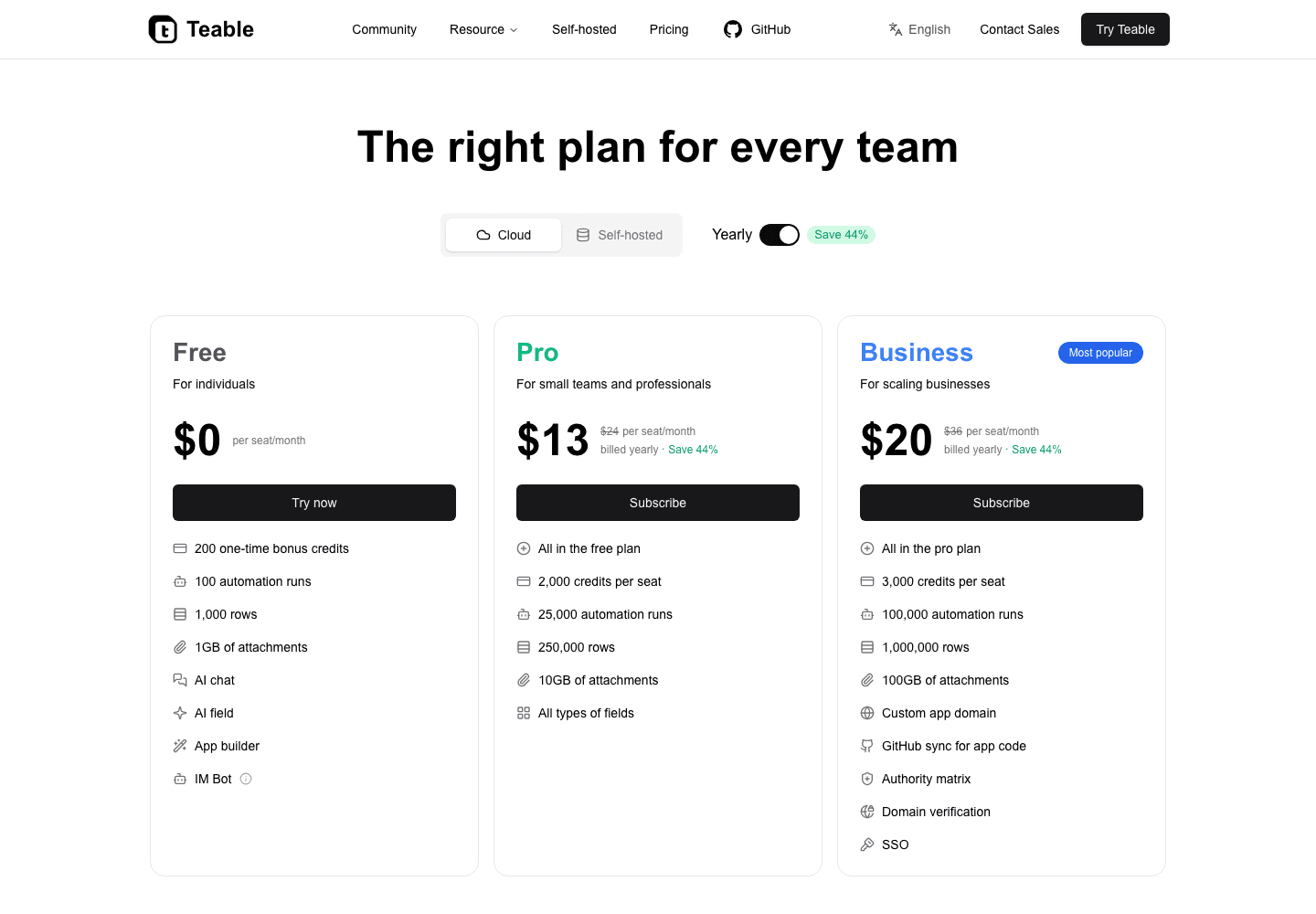
$0 Free includes AI Chat, AI Field, App Builder, 100 automation runs, 1,000 rows, and 1GB attachments
Basic sheets are free, but business operations still need extra tools around the sheet
Paid AI plan
$10 Pro gives AI Chat, AI Field, App Builder, 25K automation runs, more AI credits, and 10GB attachments
Limited$14 Business Standard adds Gemini in Sheets, but it still does not include the app, automation, email, dashboard, and database layer
Run the business
Records, AI Field, automations, dashboards, apps, approvals, reports, and email follow-ups stay in one workspace
LimitedRunning the same work around Sheets usually means Apps Script, AppSheet, add-ons, automation tools, dashboards, or databases
Business value
$20 Business adds 100K automation runs, 2,000 credits per seat, custom app domain, SSO, and 100GB attachments
Limited$22 Business Plus still leaves operations around Sheets; teams still need another app, automation, dashboard, email, or database layer
Teable
Teable pricing is stronger when a shared sheet has become business operations. Free already includes AI Chat, AI Field, App Builder, automation, and apps. Pro gives teams a live AI operations workspace for $10 per seat/month, before Business Standard adds Gemini in Sheets at $14 per user/month.
Start at $0 with AI Chat, AI Field, App Builder, 100 automation runs, 1,000 rows, and 1GB attachments.
$10 Pro gives AI Chat, AI Field, App Builder, 25K automation runs, more AI credits, and 10GB attachments.
$20 Business adds 100K automation runs, 2,000 credits per seat, custom app domain, SSO, and 100GB attachments.
Google Sheets
Google Sheets can be free or paid, but it remains a spreadsheet. Running operations still requires Apps Script, AppSheet, add-ons, automation tools, dashboards, databases, or other products around it.
Basic sheets are fine for simple tracking.
Paid Workspace still keeps operations around the spreadsheet.
Teams need Apps Script, AppSheet, add-ons, dashboards, databases, or automation tools to run real operations.
How to move from Google Sheets to Teable
Use Add from other sources for guided Google Sheets exports, or drop messy spreadsheet files into Teable AI and let it plan the workspace before importing.
Option 1
Use Add from other sources
1Export the Google Sheet as Excel or CSV, or prepare clean Excel or CSV files.
2Open Add from other sources and choose spreadsheet import.
3Upload the exported file.
4Review the detected sheets, columns, field types, and field mappings.
5Import the rows into Teable as typed fields and live records, then use them in views, AI Field, automations, dashboards, apps, and email follow-ups.
Option 2
Drop the files into Teable AI
1Upload messy Google Sheets exports, CSV files, or related spreadsheet files directly to Teable AI.
2Tell Teable AI what business workflow the sheets are supposed to become.
3Let Teable AI analyze sheets, columns, field types, and suggested field mappings before import.
4Confirm the plan, import the data as live records, then let Teable AI configure views, AI Field, automations, dashboards, apps, and email follow-ups.
If Google Sheets is only for lightweight collaboration, keep it there. If it is running customers, approvals, campaigns, finance requests, reports, or operations, it is already doing a job spreadsheets were not built to do. Move that work into Teable so the same data can run AI workflows, apps, automations, dashboards, and email follow-ups.
Google Sheets users usually ask
Is Teable a Google Sheets alternative?
Yes. Teable can replace Google Sheets-based business workflows when shared spreadsheets become crowded with tabs, formulas, comments, scripts, add-ons, manual updates, and handoffs, and the team needs live records, AI Field, automations, dashboards, apps, approvals, and workflow history.
What is the main difference between Teable and Google Sheets?
Google Sheets is an online spreadsheet for collaborative editing, formulas, analysis, charts, and sharing. Teable is the AI spreadsheet for business, built to turn rows into live records, AI workflows, automations, dashboards, apps, and email actions.
When should a team move business work out of Google Sheets?
Move when the sheet becomes the operating system for leads, onboarding, projects, campaigns, finance requests, approvals, reporting, or operations. That is when tabs, formulas, scripts, comments, add-ons, and manual updates start slowing the business down.
Can Teable import Google Sheets data?
Yes. Export Google Sheets as Excel or CSV, then use Add from other sources to analyze sheets and columns, infer field types, map fields, and import the data as live records.
Can Teable handle messy Google Sheets migration?
Yes. For messy sheet work, drop the spreadsheet exports into Teable AI, explain what business workflow they should become, review the suggested structure and field mappings, then import the data as records for AI Field, automations, apps, dashboards, and email follow-ups.
Does Google Sheets have AI?
Google Workspace includes Gemini in Sheets on some paid business plans, and it can help with spreadsheet work. Teable is different: AI Field, Teable AI Automation, App Builder, and email agents work from live business records instead of staying inside a sheet.
Can Teable replace Apps Script workflows?
Yes, when the workflow should run from live records. Teable AI Automation can build around owners, statuses, files, AI Field output, approvals, reports, Slack updates, webhooks, email follow-ups, and run history without making the sheet the workflow backend.
Can Teable build apps from Google Sheets-style data?
Yes. Teable App Builder can generate dashboards, portals, forms, approval tools, booking pages, internal tools, CRUD apps, and operational apps directly from imported spreadsheet data.
Is Teable better value than Google Sheets for operations?
Yes, when the sheet is running business operations. Google Sheets is free for basic spreadsheets, but running operations still needs extra tools around the sheet. Teable Free includes AI Chat, AI Field, App Builder, automation, and apps, while Pro is $10 per seat/month for a live AI operations workspace.
Do teams need to stop using Google Sheets completely?
No. Google Sheets can remain useful for lightweight collaboration, analysis, and simple shared lists. Teable is for workflows that have outgrown sheets and now need live data, AI operations, automations, apps, dashboards, and workflow history.
Move from Google Sheets to Teable
Turn your data into AI workflows and custom apps that 100% fit your business.